
Viking Gate Repair in Corona: A Homeowner’s Guide
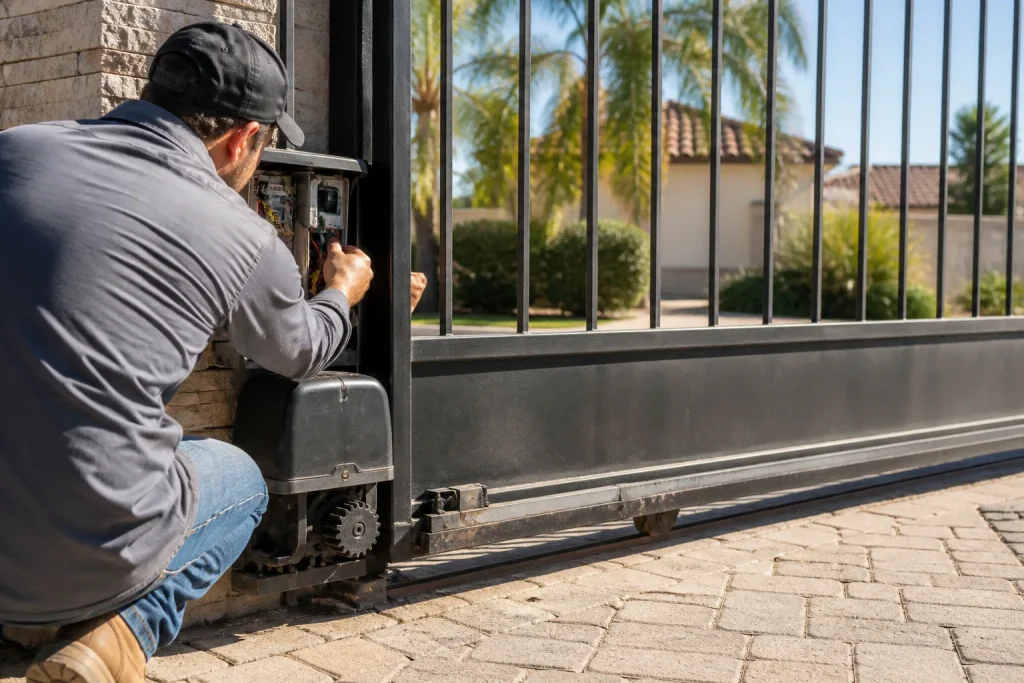
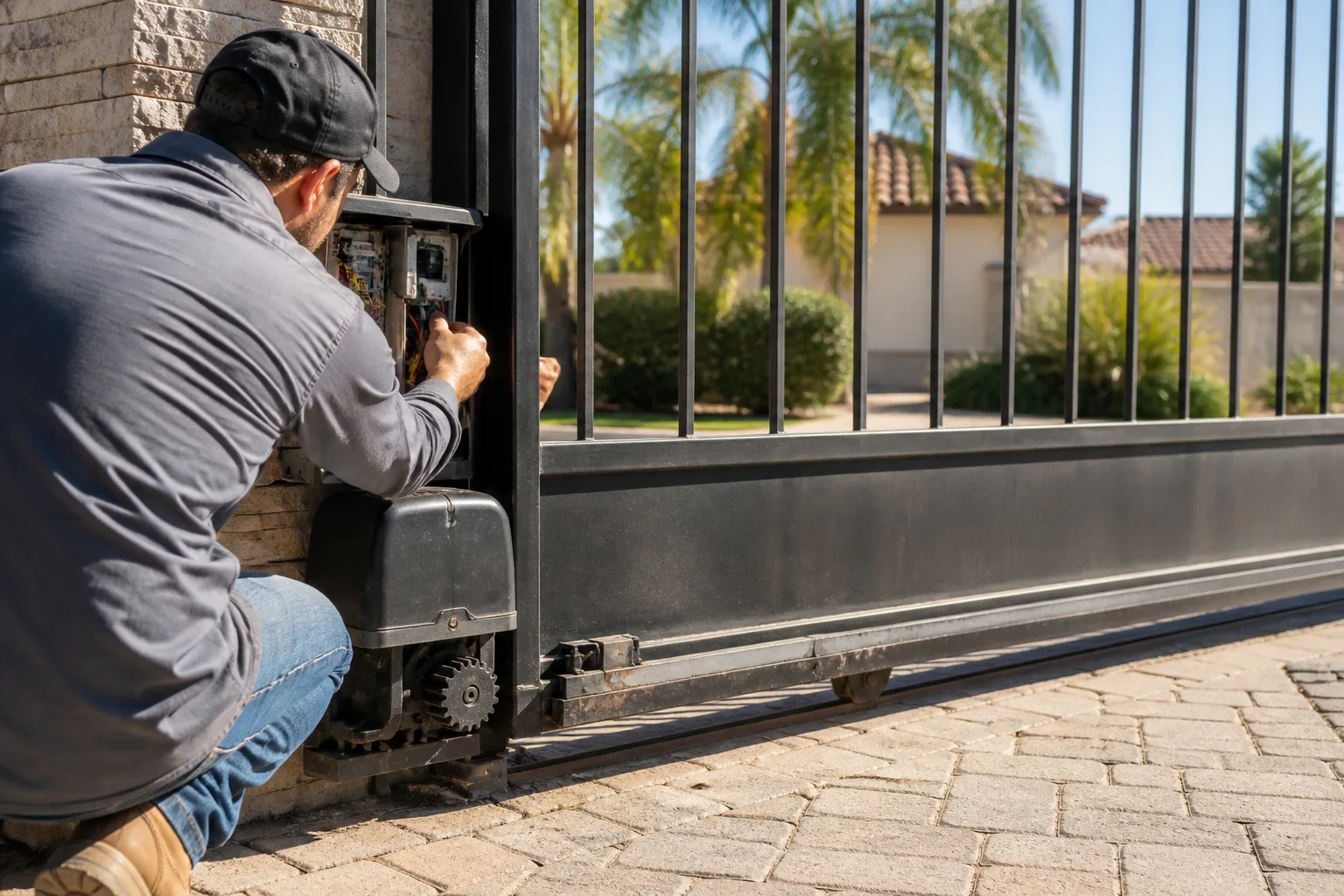
Viking gate openers fail differently than other brands, and understanding those differences will save you money. In Corona’s heat, the three failures we see most are swollen capacitors in August, limit-drift after summer power surges, and corroded logic board contacts from sprinkler overspray. If you’d rather not open the control panel yourself, call Ironworks Gate Co. home at (424) 300-4078 and a live person will answer, day or night.
Here’s what we want every homeowner in this city to know before touching a screwdriver.
- Viking’s dual-encoder design means generic diagnostic advice often misses the real problem. A tech who doesn’t know the system can make a bad situation permanently worse.
- The most common Viking failures in Corona follow a seasonal pattern tied to heat, power, and irrigation. Recognizing the pattern narrows the fix.
- Never reset a Viking opener without clearing fault codes first. The unit can lock into a permanent error state, and we see this happen more often than we’d like to admit.
- Viking certification matters more for this brand than for most residential openers. The dealer network in the Inland Empire is sparse, so knowing what to ask a prospective technician saves you from paying twice.
Why Viking Gate Openers Are Different (and Why It Matters in Corona)
Most residential gate openers use a single encoder to track arm position. Viking uses two. The primary encoder sits on the motor shaft and counts rotations. The secondary encoder sits on the output arm and measures actual gate position. The control board compares the two readings continuously. When they agree, the gate moves smoothly and stops exactly where it’s supposed to. When they disagree, the board registers a fault and stops the motor.
That design is the reason a Viking opener keeps a 400-pound gate closing square year after year. It’s also the reason a technician who treats it like any other brand can cause real damage. A standard diagnostic flow for a single-sensor opener starts with checking the motor, then the board, then the limit switches. On a Viking, if the secondary encoder reports a position the primary encoder doesn’t confirm, the board may shut down entirely. Unplugging and replugging connectors while the board is powered, which many generalist techs do out of habit, can send a voltage spike through the logic circuit. We’ve been called to Corona driveways where the control board was bricked in under ten minutes by a well-meaning handyman with a multimeter.
What you need to know as a homeowner: when someone opens the panel on a Viking opener, the first diagnostic step is reading the board’s fault log through the LED sequence or the programmer interface. If a tech skips that step and starts reseating connections, ask them to stop. You’re allowed to watch. If the person can’t name both encoders and explain what each one does, thank them and call someone else.
Corona’s climate adds a specific stress here. The heat on an August afternoon pushes an opener’s internal temperature well past the point where cheap components sweat. On a Viking unit, the dual encoder setup generates a little more running heat than a single-sensor opener, which means the cooling airflow around the control enclosure matters more than on other brands. A Viking opener mounted in full western sun, with no shade structure, runs hotter than the same unit on a shaded post. Homeowners in neighborhoods like Sierra del Oro and Horsethief Canyon tell us the same story: the gate worked for nine years, then stopped working in the middle of July. That’s not a coincidence.
The Three Viking Failures We See Most in Corona
There is a pattern to the breakdowns we fix in this city, and it repeats every year. Knowing the three big ones will help you describe the problem accurately over the phone, which gets the right tech to your house with the right parts on the first trip.
1. Capacitor Swell in Summer
The motor start capacitor in a Viking opener is a cylinder about the size of a D battery, mounted on or near the motor housing. In sustained heat above 95 degrees, which Corona delivers for weeks at a stretch between June and September, the electrolytic fluid inside the capacitor expands. The top of the cylinder, which should be flat, starts to bulge. A bulged capacitor still tests as “functioning” on a simple continuity check, but the unit will hum without moving the gate, especially first thing in the morning or after a cool night.
If your gate hums for two seconds and stops, or if the arm stutters and then dies, tell the tech you suspect capacitor swell. A certified Viking tech will check the capacitor’s physical shape before testing voltage. A generalist often skips that visual check and replaces the motor first, which costs hundreds of dollars and doesn’t fix the problem.
2. Limit-Drift After Power Surges
Corona sits in a pocket where afternoon thunderstorms roll off the Santa Ana Mountains and play with the power grid. Every lightning season, we see a cluster of Viking openers that worked perfectly on Friday and opened halfway on Monday. The cause is usually limit-drift: a power surge interrupts the control board’s memory of where the open and close limits sit, so the board defaults to a conservative setting that stops the gate early.
The symptom is specific. The gate opens about 70 to 80 percent of the way and stops, every time. It still closes fully. Or the gate closes fully but won’t latch, leaving a two-inch gap at the post. If you hear the motor run normally and the gate just stops short, you most likely have limit-drift, not a bad motor.
Fixing limit-drift requires re-teaching the limits through the programming interface. That sounds simple, but on a dual-encoder Viking, the re-teach process must be done in the correct order: clear existing limits, set the primary encoder’s zero point, then match the secondary encoder to the arm position. Do that incorrectly and the gate will slam against the post at full force, or worse, reverse and trap something underneath. This is one of those fixes that looks easy on a YouTube video and ends in a bent arm and a service call.
3. Oxidized Logic Board Contacts from Sprinkler Overspray
This one is uniquely Inland Empire. In most Coronan neighborhoods, irrigation sprinklers are positioned near driveway gate posts because that’s where the landscaping beds are. The spray drift settles on the gate operator housing. Over years, moisture seeps into the control enclosure through the cable entry and settles on the logic board contacts. The result is a greenish-white oxidation on the connector pins.
The symptom is intermittent and maddening. The gate works fine all day. Then at 6 a.m., when the sprinklers have just run, it refuses to open. Or the gate opens halfway, stops, and the LED on the motor blinks a fault code. The homeowner calls it in as an electrical gremlin. What we find is oxidation bridging the contacts on the board.
The fix is a board cleaning with a proper contact cleaner, followed by sealing the cable entry with a drip loop and repositioning the adjacent sprinkler head a few degrees. In our experience, this is the cheapest repair a homeowner will ever book, and the most commonly misdiagnosed by generalists who quote a full board replacement for a problem a can of contact spray and ten minutes would solve.
Read the Blink Codes: A Homeowner’s Field Guide
Every Viking opener has a diagnostic LED on the control board. When the gate misbehaves, the LED blinks a sequence that points to the fault. You can read that sequence yourself, and relaying it to a technician over the phone saves a diagnostic fee and gets the right part loaded on the truck.
Here’s the plain-language version of what the most common blink patterns mean. This sequence assumes a standard Viking control board; if your model has an LED display instead of a single LED, the codes appear as numbers.
- One blink, pause, repeat: Primary encoder fault. The motor shaft sensor isn’t reporting. This is usually a wiring break at the motor connector.
- Two blinks, pause, repeat: Secondary encoder fault. The arm position sensor is unresponsive or misaligned. This is the code most often misread as a “bad board.”
- Three blinks, pause, repeat: Limit switch error. The gate traveled past its set limit. This follows a power surge or a manual gate shove.
- Four blinks, pause, repeat: Obstruction or amperage overload. The motor pulled too much current. Often a physical obstruction on the track, but in the summer, a swollen capacitor can trip this same code.
- Five blinks, pause, repeat: Internal system error. A catch-all that usually means the control board needs professional diagnostics.
One vital rule: do not press the reset button or cycle power to clear a fault code after reading it. On Viking’s system, a reset while the fault is still active can lock the board into a persistent error state. When that happens, the opener shows the same fault over and over, even after the actual problem is fixed, because the board’s memory latched onto the error. A certified tech can clear the lock with the programmer. If the unit has been locked, that’s a quick fix but it requires the right interface.
Photograph the LED mid-sequence with your phone. A blurry video counts. The tech can count the blinks from the video, and you avoid standing out on the driveway in the heat counting lights.
What to Ask Before Anyone Opens a Viking Control Panel
Viking’s dealer network is dense in some parts of Southern California and surprising thin in the Inland Empire. The brand distributes through a limited dealer channel, which means the gap between “certified Viking dealer” and “guy with a truck who has seen a Viking before” is filled with uncertified shops doing their best.
Before you let anyone touch a Viking opener on your Corona property, ask four questions:
- “Are you a certified Viking dealer or factory-trained on Viking equipment?” If the answer is anything but a yes with documentation, move on. The brand’s technical literature is specific, and guessing costs you money.
- “Do you carry the Viking programmer interface?” The programmer reads fault history, clears error states, and performs proper limit-setting. Without it, a tech cannot fully diagnose or repair a modern Viking unit.
- “Can you explain the dual-encoder design to me?” The tech doesn’t need to give a lecture, but they should be able to say, in one sentence, what the two encoders do. If they stare blankly, they haven’t trained on this brand.
- “What’s your diagnostic process before you touch any wiring?” The correct answer is: read the fault log first. Any other answer means they’re about to guess with your opener.
We service gate repair in Corona and hold the certifications required to work on Viking equipment properly. The difference between a certified diagnostic and a guess is usually the difference between a $150 repair and a $950 board replacement. That’s not an exaggeration, and we have seen both outcomes on this exact brand.
When to Stop Reading and Pick Up the Phone
Some problems are worth fixing yourself: a gate that scrapes a little, a keypad with a sticky button, a photo-eye that needs a wipe. Viking openers are not on that list once you’re dealing with encoder faults, board errors, or any code that repeats after a power cycle. The unit is a closed system, and the failure modes stack on top of each other. A swollen capacitor stresses the board. A stressed board misreads the secondary encoder. A misread encoder triggers an obstruction fault. By the time you’ve replaced two parts and the gate still won’t move, you’re deep into time and money you didn’t need to spend.
We pulled a Viking unit out of a driveway over in Eagle Glen a few weeks back. The homeowner had been fighting it for two months. Two other companies had looked at it. The first replaced the battery. The second replaced the motor. The gate still stopped mid-cycle every third operation. The actual fault was a corroded secondary encoder connector, the kind of thing a tech spots in the first five minutes if they’ve been trained on Viking equipment. The repair took under an hour, and the gate has moved perfectly since.
If you’re in Corona and your Viking opener is acting up, call (424) 300-4078. A live person answers. We’ll ask you to read the blink code if you can, and we’ll tell you honestly whether it’s a fix we can guide you through over the phone or a job that needs a truck in your driveway. Upfront pricing is settled before a single bolt is turned, and every completed repair carries our gate motor & opener service in Corona guarantee: the 90-Day Done Right Promise, in writing.
Related services: gate installation in Corona.
The Bottom Line
Viking gate openers are different, and in Corona’s heat they fail in specific, predictable ways. The homeowners who know the three patterns (capacitor swell, limit-drift, oxidized contacts) and can read the four most common blink codes will diagnose 80% of problems before a tech even arrives. The remaining 20% are jobs where calling a certified tech costs less than guessing once.
If you’re in Corona and need help, Ironworks Gate Co. offers free estimates and 24-hour live phone support. Call (424) 300-4078 and talk to a person, not a queue.
Frequently Asked Questions
Most Viking gate repair work in Corona falls between $150 and $450, depending on the fault. A corroded board cleaning runs under $200 in most cases. A capacitor replacement typically lands between $180 and $280 including the part. A full control board replacement starts around $600 and climbs from there. The price is quoted and agreed before any work starts, so there’s no surprise on the invoice. Call (424) 300-4078 for an exact quote, and ask about our $50 off any repair over $250.
In most cases, yes. We carry common Viking parts on the truck, including capacitors, connectors, and encoder assemblies, so a single-visit repair is the norm rather than the exception. If you call before noon and tell us the blink code, there’s a good chance the gate moves again before dinner. Call (424) 300-4078 and a live person will give you a realistic time frame, not a callback queue.
In this city, the two most common reasons are a swollen motor start capacitor from sustained heat or limit-drift after a power surge. Both produce the same symptom: the gate opens partway and stops, every time. A certified tech can distinguish between them in about ten minutes with a voltmeter and the programmer interface. Our seasonal tune-up at $89 catches both before they strand a car in the driveway.
Yes. We’re trained and certified on nine major gate-automation brands, including BFT, Linear, and Ghost Controls. The same diagnostic discipline applies across all of them: read the fault first, fix the cause, verify the fix, and stand behind it in writing. Call (424) 300-4078 for a free estimate, whatever brand is on your driveway.
Written by Victor Salinas, Owner at Ironworks Gate Co., serving Corona since 2013.
Need Gate Repair Help?
Call Ironworks Gate Co. - licensed & insured, here with fast after-hours help in Corona.
(424) 300-4078