
Quick Summary
This comprehensive walkthrough provides gate repair how to & troubleshooting guides in Corona to help property owners systematically diagnose stuck operators, safety sensor faults, and mechanical drag. Ironworks Gate Co. details essential diagnostic steps for isolating power disruptions and physical track obstructions while highlighting the critical safety limits of DIY maintenance. After reading, homeowners will understand how to resolve minor operational issues safely and recognize when to schedule a professional on-site diagnostic assessment for complex electrical or structural repairs.
Corona Gate Repair Guide: Fix Stuck Operators Fast
If you are looking for practical gate repair how to & troubleshooting guides in Corona, this guide walks you through diagnosing stuck operators, electrical faults, and mechanical drag. Whether your gate stopped halfway across the driveway or refuses to respond to keypads, you can use these steps to isolate potential issues safely or determine when to call in a professional.[3]
Automated entry systems operate under heavy mechanical loads and high electrical current. Historical estimates from the U.S. Consumer Product Safety Commission (CPSC) indicate that 32 deaths, including 20 children, occurred between 1985 and 2001, and nearly 25,000 injuries occurred from 1990 through 2000, including approximately 9,000 children under 15, with more than 2,000 annual emergency-room treatments involving the head, neck, arm, or hand. Taking a methodical, safety-first approach protects your equipment and your household while you work through the diagnostic sequence.[1]
Review the steps below to pinpoint why your gate failed, check your safety sensors, and get your system moving again.
Why Is My Automatic Driveway Gate Not Opening in Corona?
Why Is My Automatic Driveway Gate Not Opening in Corona? in brief: If your gate fails to open, inspect the main breaker, check for physical track obstructions, and clean the optical photo eyes. Physical obstructions, power or control failures, and entrapment-protection faults are documented possible causes of operational failure.[4]
When you troubleshoot driveway gate failures on your property, work through this step-by-step diagnostic sequence:
Immediate Power and Safety Sensor Checks
- Verify electrical supply: Check your main breaker panel and any sub-panels near the gate for tripped breakers or power interruptions.
- Inspect photo eyes and safety edges: Wipe dust, spiderwebs, and debris off sensor lenses. Misalignment, obscured lenses, or sensor faults can cause the control board to halt operation. Never bypass these safety devices to force operation.
- Check manual disconnects: Use the manufacturer key or release lever to test whether the gate swings or slides freely by hand. Where California emergency exit requirements apply, exit-restricting devices cannot prevent emergency egress when they fail.
Because historical CPSC estimates recorded 32 deaths (including 20 children) from 1985 through 2001 and more than 2,000 emergency-room treatments per year from 1990 through 2000 involving the head, neck, arm, or hand, never force an operator arm or pull a bound chain with excessive force.
Documented Causes of Operator Performance Stoppages
Driveway gate operators can experience operational stoppages due to physical obstructions, mechanical binding, power supply issues, or safety sensor interruptions. High operating temperatures can also lead to internal motor thermal overload cutoffs shutting the motor down temporarily until it cools. According to technicians at Ironworks Gate Co., identifying whether a stoppage stems from mechanical drag, electrical delivery, or sensor faults requires step-by-step diagnosis.
Automatic Gate Repair in Corona: Diagnostic Steps and Solutions
To evaluate an automatic gate effectively, separate electrical problems from mechanical resistance before removing protective covers. Check the main power switch, inspect remote batteries, test the safety sensors, and confirm that all safety circuits remain fully functional.
Intermittent Operation vs. Complete Motor Failure
An intermittent gate may indicate issues such as sensor misalignment, deteriorating backup batteries, or mechanical binding along the gate track or hinge points. A completely unresponsive gate with unlit control board indicators may point to blown fuses, a tripped breaker, or a power supply failure, which requires manufacturer-specific testing to confirm. During troubleshooting, keep all safety devices active. Where California emergency exit path rules apply, systems must not prevent emergency egress.[2]
When to Reset the Logic Board
The correct reset procedure varies by opener model. Follow the manufacturer’s manual for specific reset and diagnostic instructions, de-energize equipment as directed by manufacturer safety guidelines, and avoid working on energized components. If cycling power or standard reset procedures do not resolve the issue, contact a qualified technician to conduct manufacturer-specific testing on the control board.
Gate Opener Repair in Corona: Troubleshooting Motors and Drive Systems
Evaluating an unresponsive gate motor starts with listening closely to what happens when you activate the operator. The sound of the motor reveals possible electrical, electronic, or mechanical issues that require further testing.
Diagnosing Mechanical Sounds
Grinding sounds may indicate potential internal gear wear or stripped drive components, which can occur when an operator works against a sagging or binding gate frame. A quiet hum without physical movement is a possible indicator of a failing start capacitor, insufficient incoming voltage, or an arm jammed against a physical stop, each requiring component testing to confirm.
Testing System Components Safely
Rechargeable backup batteries degrade over time and can cause an operator to stall or operate sluggishly under load. Testing high-voltage transformers and internal motor windings poses electrical shock hazards and should be left to trained technicians. Where applicable California emergency exit requirements apply, exit paths must be maintained in compliance with relevant standards.[5]
Electric Gate Repair in Corona: Wiring, Loop Detectors, and Power Systems
Need gate repair how to & troubleshooting guides in corona?
We’re available now - call for a fast, free estimate.
Electric gate breakdowns often involve damaged underground loop wiring, worn control cables, or electrical component faults in the main operator housing.
Troubleshooting In-Ground Exit Loops
When a vehicle pulls up to the gate and the system fails to trigger, the underground inductive exit loop system may be faulty. Pavement deterioration, wire degradation, or water intrusion can affect loop performance. Pinpointing whether the issue lies with the loop detector module in the control box or the wire embedded in the driveway requires specialized testing equipment.
Keypad and Intercom Communication Drops
Outdoor exposure can cause wear on keypad faceplates and corrosion on hardwired intercom terminals. If an access device fails to register commands, inspect batteries on wireless units and check wire terminals for corrosion or loose connections before replacing equipment.
Driveway Gate Installation in Corona: Upgrading Aging Entryways
Upgrading an older residential gate requires pairing a suitable continuous-duty motor with structural posts capable of supporting the gate leaf over long-term use.
Replacing Older Systems
Older operators may lack modern safety features or duty ratings suited to heavy structural gates. Upgrading to a modern continuous-duty operator matched to the gate’s specific dimensions and weight helps prevent recurring stalls and premature motor wear.
Permitting and Local Guidelines
Gate installations and structural modifications must follow applicable municipal and safety guidelines:
- Clearance and Access: Driveway gates should allow adequate clearance to prevent vehicles from obstructing pedestrian pathways or roadway traffic lanes while awaiting gate opening.
- Permits: The City of Corona Building Division dashboard confirms permit and project tracking through TRAKiT and nightly updates, but does not itself establish whether a particular gate repair or installation requires a permit. Property owners should verify local permit requirements with the building authority before beginning major work.
- Safety Standards: Research briefs on UL 325 identify independent primary and secondary entrapment-protection means and manufacturer-directed installation, while exact requirements depend on the applicable standard, equipment, and installation context.
Driveway Gate Repair in Corona: Mechanical Sag, Hinges, and Track Realignment
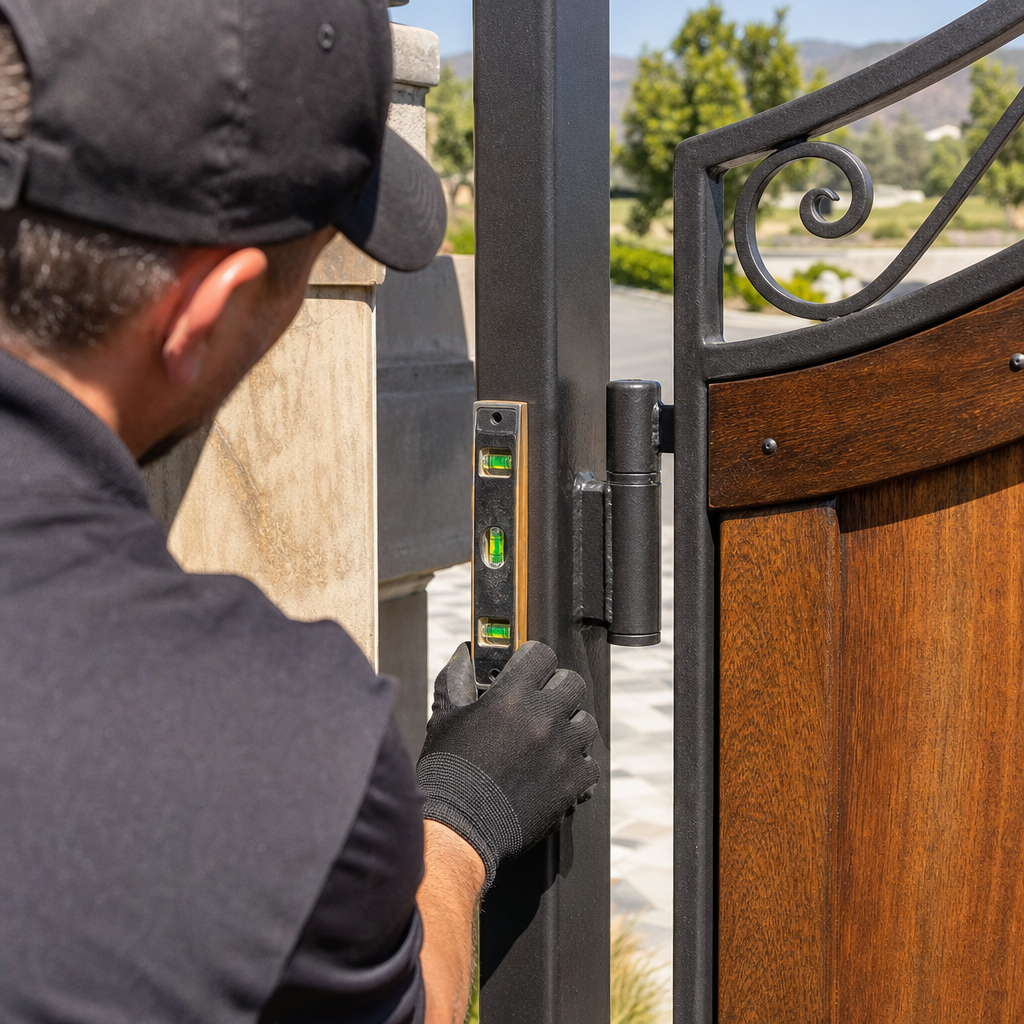
Addressing a sagging swing gate or a derailing sliding gate requires inspecting the underlying mechanical structure, including hinge assemblies, mounting posts, and ground tracks.
Fixing Dragging Swing Gates
Swing gates place continuous leverage on hinge assemblies and mounting posts. Over time, worn bearings or leaning posts can cause the gate leaf to drop, scraping pavement and placing extra load on the opener arm. Correcting this issue involves realigning the hinges, applying appropriate lubrication, and reinforcing structural posts as necessary.
Correcting Sliding Gate Track Issues
Sliding gates need clear, level tracks and aligned guide rollers to operate smoothly without derailing. Key inspection steps include:
- Inspect the track for bends, obstructions, or loose anchors.
- Check the wheels for flat spots, corrosion, or bearing wear that increases mechanical resistance.
- Inspect the upper guide rollers to ensure they maintain proper alignment without pinching the gate frame.
How to Troubleshoot Specific Gate Types
Different gate styles present distinct mechanical and operational maintenance requirements.
Wrought Iron and Steel Swing Gates
As specialists at Ironworks Gate Co. point out, heavy iron and steel gates require regular hinge lubrication and limit switch inspection to prevent binding and ensure the gate stops correctly at its open and closed limits.
Horizontal Sliding and Cantilever Gates
Accumulated dirt, leaves, and gravel in ground tracks can obstruct rolling wheels and trigger safety reversing mechanisms. Keeping the track channel clean helps avoid unexpected stoppages.
Wood-Clad and Ranch Style Automated Gates
Wood-clad gates can place substantial weight on support frames and hinges. Periodically inspect mounting brackets and hinge hardware to ensure the additional load has not caused frame distortion or loose fasteners.
Key Parts and Components: How to Identify What Failed
Need gate repair how to & troubleshooting guides in corona?
We’re available now - call for a fast, free estimate.
Pinpointing gate failures requires isolating drive components from electrical safety devices. Signs like a sagging chain, worn roller bearings, or an inactive sensor LED help identify the area of failure.
Gate Motors, Chains, and Belt Drives
If a sliding gate drive chain sags excessively or skips across the drive sprocket, it may have stretched beyond its adjustment limits and require servicing or replacement. On belt-driven systems, check for cracking or tooth wear along the belt. Mechanical drag remains a primary contributor to accelerated motor wear.
Photo-Eye Sensors, Safety Edges, and Rollers
Check diagnostic indicator LEDs on optical photo-eye sensors. A steady alignment light typically confirms communication between emitter and receiver, whereas a flashing or unlit indicator may signal misalignment, an obstructed beam, dirty optical lenses, or a wiring fault.
Troubleshooting Opener Brands: LiftMaster, DoorKing, Viking, and Apollo
Many commercial and residential operators feature onboard diagnostic indicators to help identify operational faults.
LiftMaster and DoorKing Diagnostics
- LiftMaster control boards: Many LiftMaster units utilize diagnostic LEDs near the programming buttons. Flashing LED sequences correspond to error codes documented in the manufacturer manual, pointing to potential optical sensor, edge sensor, or motor circuit issues that require targeted testing.
- DoorKing control boxes: DoorKing units often feature onboard diagnostic LEDs indicating the status of loop detectors, keypads, and safety inputs. Inspect surge components and reset buttons according to the manufacturer manual.
Viking Access and Nice Apollo Circuit Protection
Low-voltage Viking and Nice Apollo operators rely on stable DC battery supply. Degraded backup batteries may cause control boards to enter low-voltage protection modes, preventing operator movement under load until power supplies are restored and tested.
DIY Troubleshooting vs. Professional Repair: Safety and Risk Comparison
Property owners can perform basic maintenance such as sweeping ground tracks, cleaning optical lenses, and operating the manual release handle. Tasks involving line-voltage electrical connections, internal control board repair, structural welding, or entrapment-protection recalibration should be handled by qualified gate service technicians.
| Maintenance Task | Homeowner DIY | Qualified Service Professional |
|---|---|---|
| Photo-Eye Lens Cleaning & Alignment Check | ✓ Safe to perform | ✓ Full safety diagnostic |
| High-Voltage Electrical Diagnostics | ✗ Electrical shock risk | ✓ Qualified electrical testing |
| Hinge and Post Structural Welding | ✗ Structural hazard risk | ✓ Professional alignment & welding |
| Safety Device and Entrapment Testing | ✗ Incomplete calibration risk | ✓ Standard-compliant setup & testing |
Safe Homeowner Maintenance Tasks
Routine DIY upkeep includes clearing track channels, cleaning sensor lens covers, and lubricating hinges according to manufacturer specifications. Using the manual release key during a power outage is safe as long as the gate moves freely by hand. Never bypass safety sensors to force a stuck gate to operate.
High-Risk Electrical and Entrapment Hazards
Automated gates produce significant mechanical force. Historical CPSC estimates recorded 32 deaths from 1985 through 2001 and nearly 25,000 injuries between 1990 and 2000, underscoring the necessity of properly installed entrapment protection and torque settings. For high-voltage wiring, capacitor replacement, or structural frame repairs, consult a qualified gate technician.
Gate Repair in Corona: Diagnostic Considerations
Repair requirements depend on the gate type, the extent of mechanical wear, needed replacement components, and labor time. Minor sensor realignments require different procedures and parts than replacing a worn motor gearbox or rebuilding a structural hinge post.
Factors Influencing Repair vs. Replacement
Determining whether to repair or replace an operator depends on component availability, operator age, and structural condition. If an older system has multiple failing electronic and mechanical components or lacks modern entrapment-protection support, replacing the operator may be more practical than ongoing component repairs. An on-site diagnostic inspection helps establish the specific point of failure.
Frequently Asked Questions About Gate Repair in Corona
Here are answers to common questions about diagnosing and maintaining driveway gates in Corona.
What Factors Influence Automatic Gate Repair Requirements?
Repair needs depend on the nature of the issue. Routine maintenance such as cleaning optical sensors or adjusting drive chains involves minor adjustments, whereas replacing control boards, swapping drive motors, or structural welding requires specialized parts and technical service.
How Do I Manually Open My Gate During a Power Outage?
- Locate the manual release keyhole, handle, or disconnect pin on your operator chassis or swing arm.
- Disengage the release mechanism as directed by your operator manual.
- Push or slide the gate leaf open by hand until the opening is clear.
Why Does My Gate Reverse Immediately After Touching the Ground?
A gate that opens fully, starts to close, and immediately reverses often has an issue with its travel limits or track resistance. If a close travel limit is set too far, the operator may register the physical stop as an obstruction and reverse. Debris or physical resistance along the track can trigger the same reversing response.
When Should I Contact a Qualified Gate Technician?
Contact a professional technician, such as the team at Ironworks Gate Co., whenever troubleshooting involves high-voltage electrical circuits, damaged control board components, hydraulic fluid leaks, structural metal fatigue, or safety sensors that fail to operate correctly after cleaning and realignment.
Need gate repair how to & troubleshooting guides in corona?
We’re available now - call for a fast, free estimate.
Sources
- New Safety Standard for Automatic Security Gates Helps … – cpsc.gov (2000)
- California Code of Regulations, Title 8, Section 3225. Access … – dir.ca.gov
- CALIFORNIA CODE OF REGULATIONS TITLE 17. DIVISION 2 CHAPTER 3. COMMUNITY SERVICES SUBCHAPTER 4. Residential Services and Quality Assurance Article 12 -Secured Perimeters in Adult Residential Facilities and Group Homes 56068. Definitions – dds.ca.gov
- Building Division Dashboard – Corona Open Performance – corstat.coronaca.gov
- Emergency Preparedness & Classroom Security – dgs.ca.gov
Related reading: Automatic Gate Troubleshooting | Call Now-10% Off | Same-Day Service | Free Estimate
Related reading: Automatic Gate Repair – 10% Off & Free Estimate – On-Site in 60 Minutes
Related reading: Gate Safety Sensors – Call Now-10% Off – Same-Day Service – Free Estimate
Frequently Asked Questions
How can I tell if my gate failure is caused by a dead backup battery or a blown logic board?
Check the diagnostic status LEDs on your control board while the main breaker is switched on; completely dark indicators often point to a blown board, tripped transformer, or blown fuse. If the operator lights up and functions under light load but stalls or beeps during movement, degraded DC backup batteries are usually failing under the amp draw. If power cycling fails to restore normal cycling, Ironworks Gate Co. can safely test board voltage and secondary power supplies.
What should I do if my gate operator hums loudly but the gate does not move?
A humming motor without physical gate movement typically indicates a failed start capacitor, insufficient line voltage, or a seized internal gearbox. Disengage your manual release key to check if the gate leaf moves smoothly by hand or if the gate frame itself is binding against the ground or hinge posts. If the gate rolls freely by hand, avoid repeated activation attempts and have Ironworks Gate Co. diagnose the motor's electrical drive components.
How often should automated driveway gates in Corona receive preventative maintenance?
Homeowners should clear ground tracks, clean photo-eye sensor lenses, and lubricate heavy hinges every three to six months to counteract local dust and heat exposure. Heavy steel, wrought iron, and wood-clad gates should receive a comprehensive annual inspection to check chain tension, structural post plumb, and UL 325 entrapment safety systems. Scheduling regular diagnostic tune-ups with Ironworks Gate Co. helps prevent premature motor burnout caused by hidden mechanical drag.
About the author
 |
Marcus Avery Marcus Avery is a seasoned access control specialist with over 12 years of experience in the automated gate industry. Holding a degree in Electrical Engineering from California State Polytechnic University, Pomona, he brings a strong technical background to his writing on gate repair and maintenance. He aims to provide homeowners and property managers with clear, practical advice on troubleshooting common gate issues and understanding pricing structures. |
Gate not opening, off track, or opener dead?
We’re available now - call for a fast, free estimate.
Call Now - Free Estimate