
Quick Summary
When an automated driveway gate fails to open, close, or reverse unpredictably, systematic automatic gate troubleshooting helps isolate power, optical sensor, and mechanical issues to restore property security. The technical specialists at Ironworks Gate Co. recommend starting with safe preliminary checks like cleaning photo-eye sensors and inspecting tracks for resistance, while emphasizing that complex electrical faults and structural hardware problems demand certified professional repair. After reading this guide, homeowners will understand how to safely diagnose everyday gate glitches and recognize when to schedule a professional on-site assessment for an upfront, fixed-price repair quote.
Automatic Gate Troubleshooting: Step-by-Step Fix Guide
When an automated driveway gate refuses to operate properly, finding the root cause helps keep your property secure and accessible. This automatic gate troubleshooting guide walks you through basic checks for power issues, optical sensor alignment, and mechanical resistance. While simple maintenance such as cleaning a blocked photo eye or resetting a breaker can be straightforward, specialists at Ironworks Gate Co. emphasize that working around heavy moving hardware and electrical control panels requires clear safety precautions.[3]
Electrically powered gates can create entrapment and crushing hazards capable of serious injury or death, and crushing zones around such gates present pedestrian risks. Safety authorities, including the U.S. Consumer Product Safety Commission (CPSC), the Irish Health and Safety Authority, and the UK Health and Safety Executive, have highlighted these critical hazards. Automated vehicular gates may include horizontal sliding, horizontal swinging, vertical lifting, vertical pivoting, overhead pivoting, and horizontal bifolding designs as categorized under ASTM F2200 standards. CPSC guidance emphasizes key safety conditions such as eliminating pinch points, guarding exposed rollers, maintaining safe gap spacing, positioning user controls away from the moving gate, and posting warning signs. Furthermore, CPSC says automatic gates should use at least two independent entrapment-prevention mechanisms, such as an obstruction-reversing sensing device together with a secondary photoelectric or edge sensor. If safety devices fail, the gate reverses without an apparent cause, or the gate presents a crushing or entrapment hazard, stop using the gate immediately and arrange qualified service.[2]
Automatic Gate Troubleshooting: Quick Diagnosis and Immediate Steps
A systematic diagnostic approach helps determine whether your gate operator has lost electrical power, encountered an obstruction, or experienced mechanical binding.
Fast Diagnostic Checklist
- Verify the electrical supply: Check the main circuit breaker and the local power disconnect switch near the operator to ensure the unit is receiving power.
- Inspect optical safety sensors: Check the photo eyes on both sides of the gate opening. Remove dirt, cobwebs, or debris from the lenses, and verify that the sensors remain properly aligned and unobstructed.
- Test the manual release: Disengage the operator according to the manufacturer instructions to check if the gate moves freely by hand. Check for physical resistance, track obstructions, or damaged hardware.
When to Stop DIY and Cut Power
Always disconnect power before inspecting internal wiring or mechanical drive systems. Never attempt to bypass safety devices or adjust components under high tension. Stop using the gate and arrange qualified service if safety devices fail, the gate reverses without an apparent cause, or the gate presents a crushing or entrapment hazard.
Why Is My Automatic Driveway Gate Not Opening or Closing?
Need automatic gate troubleshooting?
We’re available now - call for a fast, free estimate.
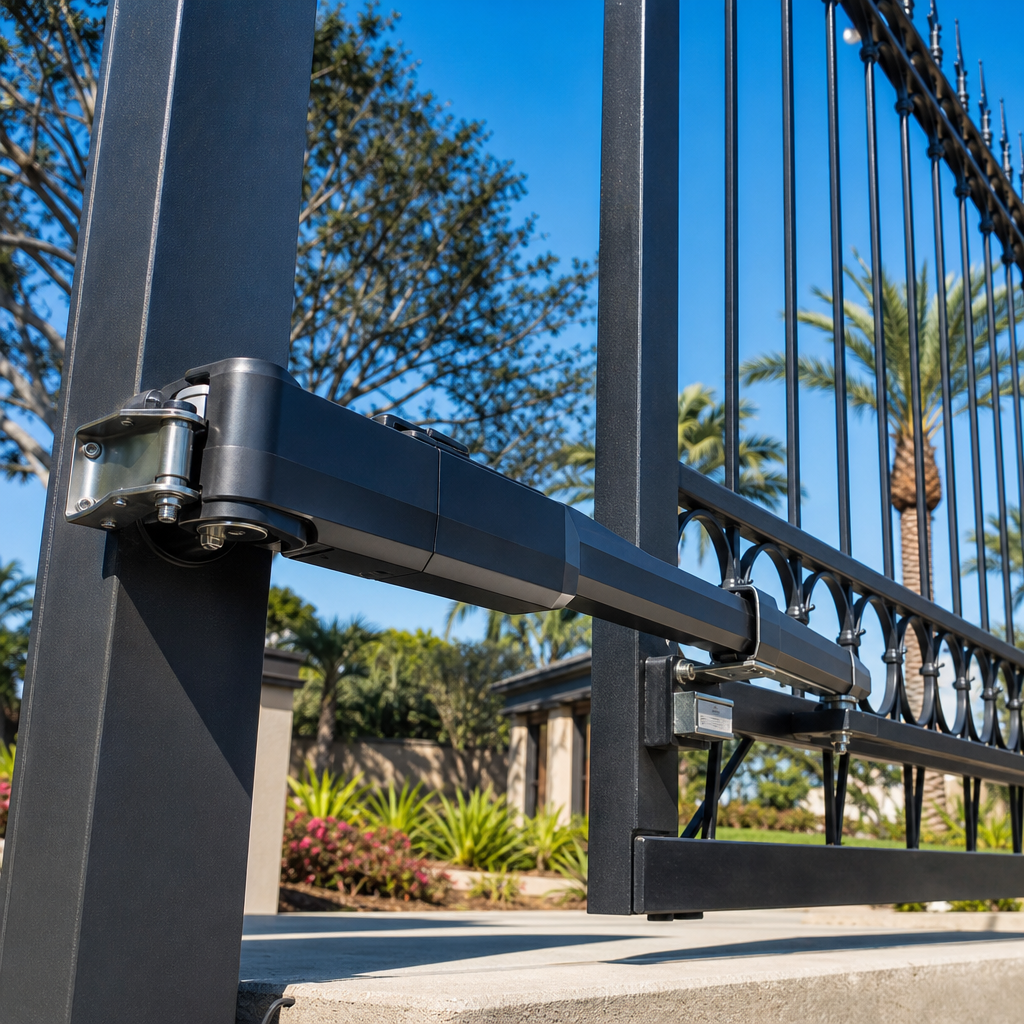
When an electric gate fails to open or close, possible causes include an obstruction, misaligned safety sensor, failed entrapment-protection device, or operator fault.[4]
Photo-Eye Sensor Alignment and Obstructions
Photo eyes project an optical beam across the entrance to detect vehicles, pets, and pedestrians. When that beam is interrupted or the sensors fall out of alignment, the operator stops or reverses gate motion. Ensure both lenses are clean and properly aligned according to manufacturer instructions.
Mechanical Track and Hardware Resistance
Sliding and swing gates require unobstructed travel paths. As noted by Ironworks Gate Co. technicians, dirt, debris, or damaged rollers and hinges can create physical resistance that triggers safety reverse mechanisms. Inspect the track or swing path to confirm it is clear of obstructions before making any operator adjustments.[5]
Physical Safety and Structural Hazards
Physical gate stability and entrapment protection are critical safety considerations. According to reports from the California Department of Public Health Fatality Assessment and Control Evaluation (CA/FACE) program, California recorded 47 work-related accidents involving fence gates derailing or falling between 1990 and 2024, resulting in 35 injuries and 12 deaths. This data highlights specific occupational risks associated with falling or derailing gates rather than a general measure of all automatic gate incidents. Property owners should ensure gates are equipped with positive stops, proper roller guards, and compliant entrapment-prevention devices installed and maintained by qualified professionals.[1]
Frequently Asked Questions About Automatic Gate Troubleshooting
Why is my automatic gate not opening or closing?
Possible causes include an obstruction, misaligned safety sensor, failed entrapment-protection device, or operator fault, as well as a tripped circuit breaker or dead remote battery.
How do I reset an electric gate opener system after a power outage?
Reset procedures vary by manufacturer and model, and technicians at Ironworks Gate Co. advise checking specific manufacturer documentation before attempting a reset. Keep people and objects away from the gate, follow the owner manual, and never bypass entrapment-protection devices.
Why does my automatic driveway gate stop halfway and reverse?
Possible causes include an obstruction, misaligned safety sensor, failed entrapment-protection device, or operator fault. If safety devices fail or the gate reverses without an apparent cause, stop using the gate and arrange qualified service.
How do I troubleshoot and clean automatic gate safety sensors?
Gently wipe the sensor lenses with a clean, soft cloth to remove dust, dirt, or cobwebs. Verify that the sender and receiver units are aligned according to the manufacturer manual and that no physical obstacles break the sensor path.
When should I call a professional gate repair technician instead of fixing it myself?
Stop using the gate and arrange qualified service if safety devices fail, the gate reverses without an apparent cause, the gate has a crushing or entrapment hazard, the gate is off its track, or you suspect electrical or structural failures.
Need automatic gate troubleshooting?
We’re available now - call for a fast, free estimate.
Sources
- [PDF] 2024-11-20-COPF-CODD-Hummingbird-Alliance-Meeting-Log.pdf – cpsc.gov (2024)
- Injury patterns and epidemiology of automatic door-related … – hsrc.himmelfarb.gwu.edu (2024)
- New Safety Standard for Automatic Security Gates Helps … – cpsc.gov (2000)
- [PDF] Investigation Guideline Product: Automatic Gate Operators Appendix – reginfo.gov (2000)
- CPSC Data – cpsc.gov
Related reading: Sliding Gate Repair | Call Now-10% Off | On-Site in 60 Minutes | Free Estimate
Related reading: Automatic Gate Repair – 10% Off & Free Estimate – On-Site in 60 Minutes
Related reading: Gate Safety Sensors – Call Now-10% Off – Same-Day Service – Free Estimate
Frequently Asked Questions
How can I tell whether my automatic gate issue is mechanical or electrical?
Disengage the manual release mechanism and slide or swing the gate by hand; if you feel grinding or resistance, the problem is mechanical, such as worn hinges, track debris, or damaged rollers. If the gate moves smoothly manually but fails to operate automatically, the fault lies in the electrical system, photo-eye sensors, or control board. The technical specialists at Ironworks Gate Co. can perform advanced electrical diagnostics to isolate the exact component failure.
What should I do if my sliding gate comes off its track?
Cut power to the operator immediately and do not attempt to force a derailed gate by hand, as heavy gates pose severe crushing and falling hazards. Keep vehicles and pedestrians away from the perimeter until the structure is stabilized. Contact Ironworks Gate Co. to inspect positive stops, guide rollers, and track alignment to restore safe, code-compliant operation.
How do I schedule a professional diagnostic inspection for my gate system?
You can contact Ironworks Gate Co. directly to schedule a free on-site gate assessment. Our technicians evaluate both mechanical hardware and electrical safety devices, providing an upfront, fixed-price repair quote before any work begins.
About the author
 |
Marcus Avery Marcus Avery is a seasoned access control specialist with over 12 years of experience in the automated gate industry. Holding a degree in Electrical Engineering from California State Polytechnic University, Pomona, he brings a strong technical background to his writing on gate repair and maintenance. He aims to provide homeowners and property managers with clear, practical advice on troubleshooting common gate issues and understanding pricing structures. |
Gate not opening, off track, or opener dead?
We’re available now - call for a fast, free estimate.
Call Now - Free Estimate