
Quick Summary
A malfunctioning sliding gate compromises property security and introduces severe entrapment hazards, requiring structured diagnostics across ground tracks, rollers, safety sensors, and motor controls. Ironworks Gate Co. delivers specialized sliding gate repair across the Inland Empire, combining heavy-duty mechanical expertise and precision electrical diagnostics to resolve track, roller, chain, and operator faults on the first visit. Readers will understand how to identify critical hardware and sensor failures and can schedule a free on-site inspection or call local dispatch for dependable same-day sliding gate repair.
Sliding Gate Repair: Reliable Service
A sliding gate that sticks halfway across the driveway or refuses to budge when you leave for work throws off your entire day. Beyond the frustration, a malfunctioning gate is an immediate security concern and a serious physical hazard. When tracks warp, rollers seize, or optical sensors fail, restoring safe operation requires accurate diagnostic work and mechanical alignment rather than temporary patchwork.
Professional repair services can diagnose and resolve mechanical and electrical failures across automated gate systems, from damaged ground tracks and degraded bearings to control board issues. Because automated systems involve high-voltage electrical components and heavy moving assemblies, hiring qualified professionals is recommended for electrical, automatic-control, heavy-gate, and roller-replacement work. If a gate is binding, grinding, or unresponsive, a full system inspection by specialists such as Ironworks Gate Co. can determine the necessary repairs.
Sliding Gate Repair: What You Need and How to Start
Diagnosing an electric sliding gate starts with a systematic check of the physical track, drive components, and electrical safety circuits. Common reported causes of gate malfunction include loss of power, disengaged gear motors, dead transmitter batteries, stuck controls, dirty or misaligned photocells, and faulty sensing edges. Physical obstructions or mechanical drag along the track can also cause the operator to stall or reverse.[4]
Safety is critical during any assessment. Powered gates should never be operated or manually repositioned until power is isolated and the gate is securely restrained. Before inspecting mechanical parts, switch off the dedicated circuit breaker to disconnect all power to the gate operator, and never reach near the drive chain, sprockets, or guide rollers while the system is energized.[3]
Essential Tools and Safety Equipment
For initial visual inspections, the following safety gear and standard tools are commonly used:
- Heavy leather work gloves and protective eye gear
- Digital multimeter for checking line voltage and control board circuits (for use by qualified personnel)
- Spirit level or string line to check track grade and alignment
- Set of metric and standard hex wrenches, socket set, and adjustable wrenches
- Manufacturer-recommended lubricant for mechanical hardware
- Mechanical supports or clamps to secure the gate panel against tipping
Initial Inspection Checklist
- Isolate Power: Turn off the circuit breaker feeding the operator to eliminate the risk of accidental activation.
- Secure and Restrain the Gate: Ensure the panel is physically stable and secured before performing any mechanical inspection.
- Disengage the Drive System: Release the manual clutch or disconnect the drive mechanism according to manufacturer instructions only after power is completely cut.
- Check Manual Travel Resistance: Once safely released, verify whether the gate glides smoothly along the track without binding, grinding, or excessive resistance.
- Inspect Safety Devices: Check that safety photo eyes and sensing edges are clean, securely mounted, and properly aligned.
Step 1: Inspect the Ground Track for Debris and Alignment Issues
A ground track must remain flat, straight, and properly supported across the entire travel span. Physical debris, shifting foundations, or loose fasteners can create low spots or lateral drift that place excessive strain on the drive motor and mechanical hardware.
Clearing Obstructions and Checking the Rail
To inspect a track that is binding or causing the gate to derail:
- Clear packed dirt, gravel, and debris from the track channel.
- Use a level or string line along the rail to check for vertical deflection or lateral drift.
- Check for loose or damaged anchor bolts that allow the rail to flex under load.
- Consult a qualified professional, such as the technicians at Ironworks Gate Co., if the track requires re-anchoring, leveling, or structural realignment.
Step 2: Check V-Groove Rollers and Bearing Assemblies
Sliding gate wheels support the panel during operation. When roller bearings degrade or become contaminated with grit, wheels can lock up or drag across the rail, increasing resistance and putting strain on the gate operator.
Recognizing Worn Roller Bearings
Signs of bearing failure include squealing or grinding noises during travel, visible shuddering or hesitation, and abnormal wear along the top of the ground track. Worn or seized rollers should be replaced promptly to prevent damage to the track and motor.
Safety Precautions for Roller Replacement
Gate panels are heavy structural components that present severe crush and pinch hazards if not properly supported. Roller replacement and heavy-gate handling should be performed by qualified professionals with appropriate rigging equipment.
- Isolate all electrical power to the system.
- Securely clamp or strap the top of the gate to solid support posts so the panel cannot tip over.
- Use appropriate, load-rated lifting equipment to support the panel weight safely off the track.
- Remove the axle hardware, replace worn rollers with suitable bearing-equipped assemblies, and torque all fasteners to manufacturer specifications.
| Roller Type | Bearing System | Operating Characteristics | Application |
|---|---|---|---|
| Standard Steel Rollers | Shielded ball bearings | Standard noise level | Lighter residential gate panels |
| Machined Steel / Polymer Rollers | Sealed precision bearings | Lower vibration and noise | Heavy ornamental, commercial, and high-cycle gates |
Step 3: Align and Clean Safety Photo-Eye Sensors
Automatic gate systems incorporate secondary entrapment protection devices to prevent injury. According to safety reports from the U.S. Consumer Product Safety Commission (CPSC), automatic gates present severe hazards when safety features fail or are absent. The CPSC documented entrapment injuries affecting the head, neck, arms, or hands, as well as cuts, broken bones, hematomas, and amputations. In addition, the CPSC reported 32 deaths associated with automatic gates since 1985, including 20 child deaths. These gate-specific entrapment statistics are distinct from general occupational repair-and-maintenance workforce data and highlight the critical role of functioning safety systems.[1]
When an electric sliding gate refuses to close or reverses unexpectedly, a sensor fault is one possible cause among several, alongside power loss, mechanical drag, disengaged drive components, or control board errors.
Addressing Optical Obstructions and Sensor Alignment
Direct low-angle sunlight, dirt, moisture, or physical misalignment can disrupt optical safety beams.
- Clean the sensor lenses with a soft cloth to remove dust, cobwebs, and moisture.
- Check the physical alignment between the emitter and receiver or reflector.
- Inspect the diagnostic indicator lights on the sensor modules to confirm a continuous signal link according to the manufacturer’s manual.
- If sunlight interference occurs, install manufacturer-approved sensor hoods or adjust mounting positions as recommended.
Step 4: Inspect Drive Chain Tension and Top Guide Rollers
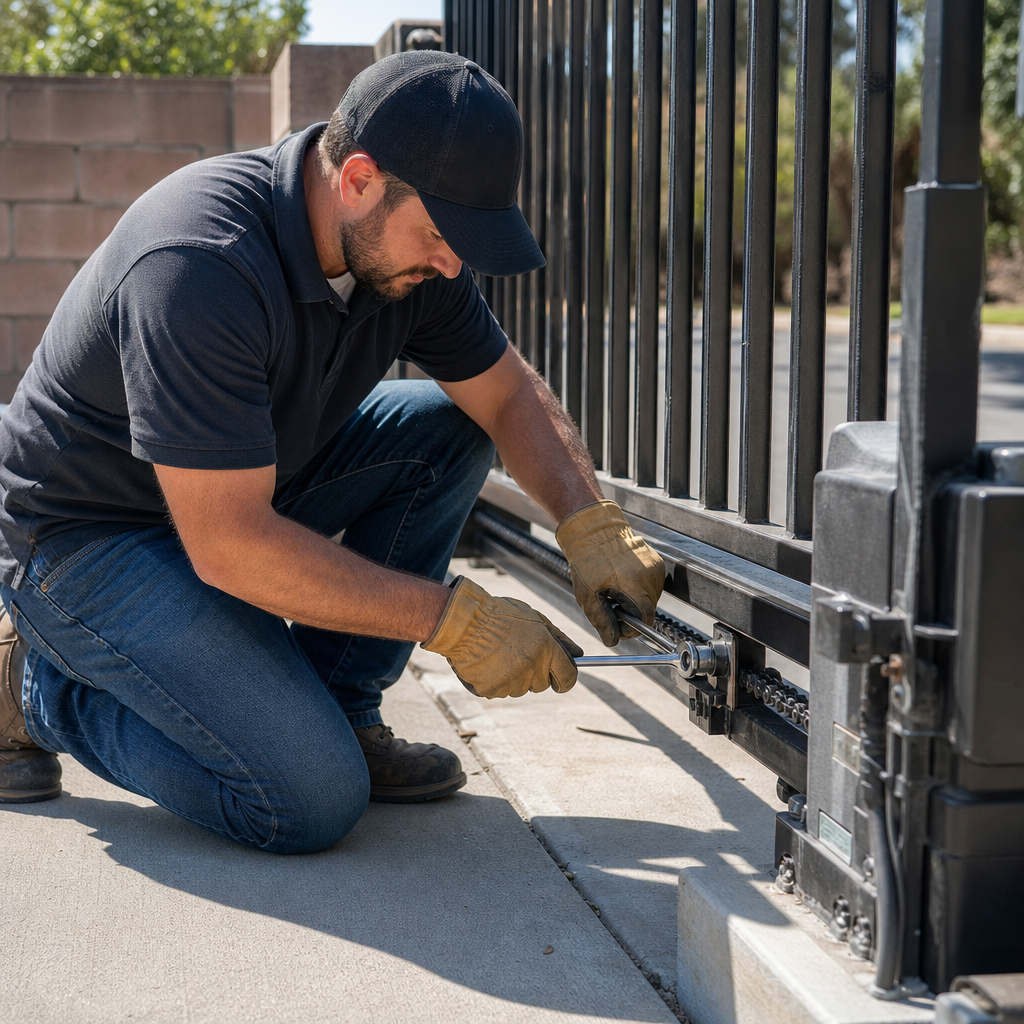
A properly adjusted drive system and guide mechanism ensure smooth horizontal travel without excessive wear on the operator components.
Checking Drive Chain Tension
An excessively loose drive chain can slap against the operator chassis or skip sprockets, while an over-tightened chain places high radial loads on the drive shaft and bearings. Adjust chain tension according to manufacturer specifications to maintain balanced operation, ensuring lock nuts and master links are securely fastened.
Aligning Upper Guide Rollers
Top guide rollers keep the gate panel vertical during travel. If posts shift, guide rollers can bind against the frame and create heavy mechanical drag. According to installation specialists at Ironworks Gate Co., guide assemblies should be adjusted according to manufacturer instructions so the gate stays securely upright while rolling freely without binding.
Step 5: Troubleshoot Electrical Controls and Operators
If mechanical movement is smooth and safety sensors are clear but the gate operator does not function, the electrical system should be evaluated by a qualified professional.
Capacitor and Motor Diagnostics
Single-phase AC gate motors use start or run capacitors to initiate and maintain rotation. A failing capacitor may cause the motor to hum without turning the drive mechanism. Testing and replacing capacitors involves high-voltage risks and should be handled by a qualified technician using proper discharge tools and testing instruments according to manufacturer tolerances.
Control Boards and Limit Switches
Electrical control boards can suffer from blown fuses, damaged relays, or loose wiring connections. Limit switches-whether mechanical, optical, or magnetic-must be properly calibrated so the operator stops travel smoothly before the gate reaches physical stops at either end of the track.
What Does Sliding Gate Repair Cost?
Sliding gate repair costs depend on the specific fault, the size and weight of the gate panel, the condition of the ground track, and whether replacement motors or electrical components are required. Minor adjustments, such as sensor realignment or limit switch recalibration, generally involve lower costs than major mechanical work, including track leveling, structural wheel replacement, or complete operator replacement. An on-site diagnostic inspection by a qualified technician from Ironworks Gate Co. provides an accurate assessment of necessary repairs and associated costs.[2]
Automatic Sliding Gate Operator Platforms
Modern automated gate systems rely on various operator types, including chain-driven, rack-and-pinion, and direct-drive units across residential, commercial, and industrial settings. Commercial and community installations often incorporate vehicle loop detectors, secondary sensing edges, and telephone entry or access keypads. Solar-powered and battery-backup configurations require functional charge controllers and maintained battery banks to ensure reliable operation during power interruptions.
Frequently Asked Questions About Sliding Gate Repair
How much does it cost to repair a sliding driveway gate?
Repair costs vary based on the specific issue, gate size and weight, track condition, and the motor or electrical components involved. Accurate pricing is determined through an on-site physical and electrical inspection.
Why is my electric sliding gate not opening or closing?
Common causes include loss of power, dead transmitter batteries, disengaged drive mechanisms, stuck controls, dirty or misaligned photocells, faulty sensing edges, or mechanical binding along the track.
How do you fix a sliding gate that jumped off its track?
First, isolate electrical power and securely restrain the gate panel to support posts so it cannot tip over. Clear any obstructions from the rail, inspect the track and rollers for damage, and use proper lifting methods to reset the panel on the track. For heavy gates, professional service from experienced providers like Ironworks Gate Co. is strongly recommended.
Can I replace sliding gate rollers and wheels myself?
Because gate panels are heavy and pose serious tip-over and crush hazards, roller replacement should be performed by qualified professionals who have the proper safety supports and lifting equipment.
What causes an automatic sliding gate motor to stop working?
Potential causes include electrical supply failures, tripped breakers, blown control board fuses, failed capacitors, worn drive gears, or safety sensor faults that prevent motor engagement.
How often should an automatic sliding gate be serviced?
Service intervals depend on daily usage cycles and manufacturer guidelines. High-traffic commercial gates typically require more frequent professional inspections than residential gates to check safety devices, chain tension, roller lubrication, and track alignment.
Sources
- Repair and Maintenance: NAICS 811 – bls.gov (2026)
- May 2023 Occupational Employment and Wage Estimates – hero.epa.gov (2023)
- New Safety Standard for Automatic Security Gates Helps … – cpsc.gov (2000)
- Proposed Rule – Safety Standard for Gates and Enclosures – cpsc.gov (2008)
Related reading: Automatic Gate Repair – 10% Off & Free Estimate – On-Site in 60 Minutes
Related reading: Gate Safety Sensors – Call Now-10% Off – Same-Day Service – Free Estimate
Related reading: Electric Gate Troubleshooting | 10% Off & Free Estimate | Same-Day Service
Frequently Asked Questions
How quickly can a stuck or off-track sliding gate be repaired in the Inland Empire?
Ironworks Gate Co. provides local dispatch for same-day sliding gate repair across the Inland Empire, arriving with the necessary rigging and parts to fix mechanical and electrical faults on the first visit. Property owners can schedule a free on-site safety inspection to quickly restore secure driveway access.
What should I do if my electric sliding gate motor hums but fails to move the gate?
A humming motor usually points to a failed start capacitor, a seized roller bearing, or excessive physical drag along the ground track. Because testing motor capacitors involves high-voltage hazards, power down the system and contact Ironworks Gate Co. for precision diagnostic testing.
How can property owners prevent repeated track alignment issues and roller wear?
Keeping the ground track clear of dirt, gravel, and debris prevents roller derailment and reduces physical strain on the operator. Upgrading to sealed precision-bearing steel rollers and scheduling routine tune-ups with Ironworks Gate Co. ensures proper guide roller alignment and smooth gate travel.
About the author
 |
Marcus Avery Marcus Avery is a seasoned access control specialist with over 12 years of experience in the automated gate industry. Holding a degree in Electrical Engineering from California State Polytechnic University, Pomona, he brings a strong technical background to his writing on gate repair and maintenance. He aims to provide homeowners and property managers with clear, practical advice on troubleshooting common gate issues and understanding pricing structures. |
Gate not opening, off track, or opener dead?
We’re available now - call for a fast, free estimate.
Call Now - Free Estimate